Blog
China Top Barite Drywall Radiation Shielding Manufacturers
China’s Barite Drywall Radiation Shielding sector is gaining attention from hospitals, dental clinics, laboratories, and imaging facilities. These projects require more than dense wall panels. They demand measured radiation data, careful layout planning, verified material quality, and trained installation teams.
Dr. Michael G. Stabin, a respected medical physicist and radiation-protection specialist, has stated, “Shielding design must be based on exposure assessment, not material claims alone.” This principle matters when comparing Chinese manufacturers. Barite drywall may combine gypsum board with high-density barite compounds. Its performance depends on density, thickness, joints, fasteners, openings, and workmanship. A small gap around a service pipe can weaken an otherwise strong barrier.
Details matter here.
Leading suppliers should provide clear technical data, batch consistency records, fire-performance information, and installation guidance. They should also explain whether their products suit diagnostic X-ray rooms, CT areas, laboratories, or other controlled environments. One product cannot fit every project. That is easy to forget.
A reliable manufacturer should cooperate with qualified shielding designers and follow the project’s approved radiation assessment. Factory photographs are useful, but they are not proof. Independent testing, traceable documentation, and practical installation experience offer stronger evidence. Even experienced buyers can overlook acoustic performance, wall loading, moisture resistance, or future equipment changes.
This guide examines China’s top Barite Drywall Radiation Shielding manufacturers through an E-E-A-T-focused lens. It considers technical credibility, manufacturing experience, documentation quality, and customer support. Some claims still require verification. That uncertainty should remain visible, not hidden behind polished marketing language.
Barite Drywall Radiation Shielding: Purpose and Key Properties
Barite drywall uses high-density barium sulfate to reduce scattered and direct diagnostic X-ray radiation. Its purpose is controlled attenuation, not complete elimination. NCRP Report No. 147 states that shielding design depends on workload, tube voltage, distance, occupancy, and use factors. Workload is commonly expressed in mA-minutes per week. Therefore, one thickness cannot serve every room. IAEA Safety Reports Series No. 47 also supports calculation-based designs and post-installation verification.
Barite-filled panels are denser than standard gypsum boards, often reaching about 2.8–3.5 g/cm³, depending on formulation. This density improves attenuation but increases wall loads. Joints, service penetrations, corners, and door frames remain vulnerable points. NCRP guidance emphasizes continuous shielding surfaces and qualified assessment. In practice, drawings may look complete, yet one poorly sealed outlet can weaken local protection. Performance data should come from tested assemblies, not density alone. That distinction is easy to miss.
Tips: Request a radiation physicist’s shielding calculation before purchasing panels. Check tested lead-equivalence data at the planned kVp. Confirm substrate capacity and lifting access. Photograph every joint before closing the wall. A small omission can become expensive. Recheck shielding after equipment installation.
China Top Barite Drywall Radiation Shielding Manufacturers - Barite Drywall Radiation Shielding: Purpose and Key Properties
Barite drywall uses high-density barium sulfate aggregate to increase mass per unit volume and help attenuate diagnostic X-rays and gamma radiation. The chart compares typical reference densities of commonly used shielding materials; actual performance depends on radiation energy, board thickness, joints, and installation quality.
Reference densities: gypsum board approximately 0.8 g/cm³, barite drywall approximately 2.1 g/cm³, normal-weight concrete approximately 2.3 g/cm³, barite approximately 4.5 g/cm³, and lead approximately 11.34 g/cm³. Values are representative engineering references rather than product specifications.
How Barite Radiation-Shielding Drywall Is Manufactured in China
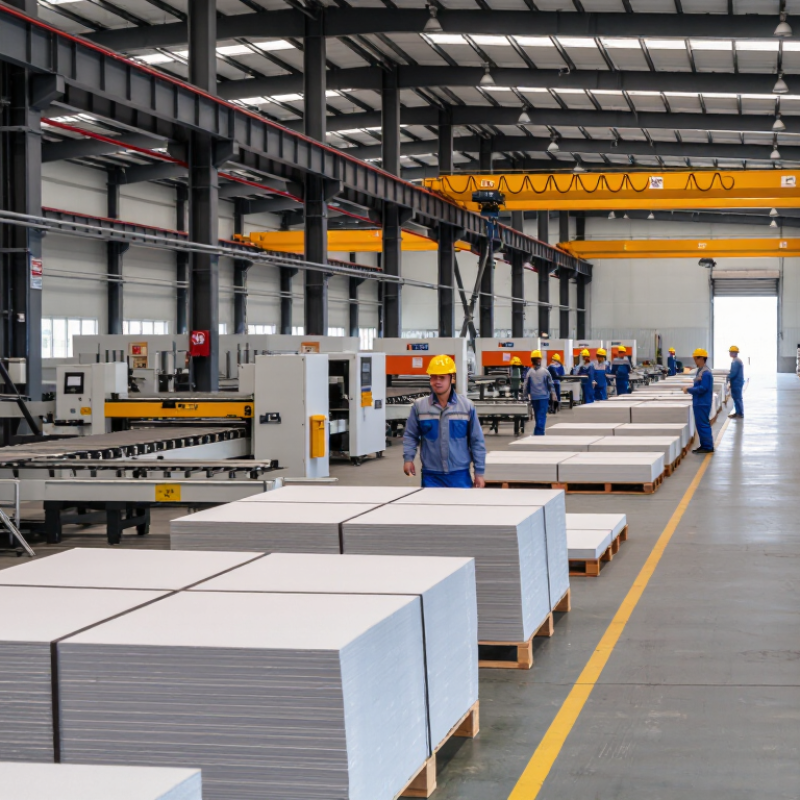
China’s barite radiation-shielding drywall is produced through controlled material preparation. Barite ore is crushed, cleaned, and milled into a consistent powder. Its high density helps reduce the passage of diagnostic radiation. Gypsum, additives, and reinforcing fibers are then blended with the barite. The mixture must remain workable. Excess moisture can weaken the finished board.
At the factory, the compound is spread between durable facing layers. Rollers control the board’s thickness and surface flatness. Pressing removes air pockets that could create weak areas. Boards then enter a drying chamber with monitored temperature and humidity. Uneven drying may cause warping or edge cracks. This remains a practical concern, especially with thicker shielding panels.
Quality teams usually check dimensions, density, moisture, bonding strength, and visible defects. Sample panels may also undergo shielding-performance testing in qualified laboratories. Production records should trace raw materials, batch numbers, curing conditions, and inspection results. Experienced manufacturers adjust the formula for different wall structures and installation demands. However, density alone does not prove reliable protection. Joint design, fasteners, cut edges, and workmanship also affect the final barrier. A rushed inspection can miss these weaknesses. Careful manufacturers therefore review both laboratory data and installation behavior before approving each production batch.
China Top Barite Drywall Radiation Shielding Manufacturers - How Barite Radiation-Shielding Drywall Is Manufactured in China
| Manufacturing Stage | Main Materials or Inputs | Typical Process Parameters | Key Quality-Control Checks | Manufacturing Purpose |
|---|---|---|---|---|
| Raw Barite Selection | Natural barite ore, primarily barium sulfate (BaSO4) | Material is selected according to mineral purity, specific gravity, moisture content, and color consistency. | Chemical composition, specific gravity, moisture, visible contamination, and particle-size suitability | Provides the high-density mineral phase required for attenuation of diagnostic X-rays. |
| Crushing and Grinding | Sized barite aggregate or barite powder | Ore is reduced to a controlled powder or fine aggregate size to promote uniform distribution in the gypsum matrix. | Particle-size distribution, oversize percentage, powder flowability, and absence of hard lumps | Improves mix uniformity and reduces local variations in shielding density. |
| Gypsum Binder Preparation | Calcined gypsum, water, setting regulators, starch or other board additives | Dry ingredients are dosed by mass and combined with water under controlled mixing conditions. | Water-to-solids ratio, setting time, slurry temperature, viscosity, and mix homogeneity | Creates a workable matrix that binds the dense barite particles into a stable panel. |
| Barite-Gypsum Blending | Prepared gypsum slurry and graded barite powder or fine aggregate | Barite content is adjusted according to the required panel density, thickness, handling characteristics, and shielding design. | Uniformity of dispersion, absence of segregation, mix density, and workability | Balances radiation attenuation, mechanical strength, manufacturability, and installation weight. |
| Board Forming | Barite-gypsum core and treated paper or reinforcing facer | The core is formed between facers or within a mold, followed by edge shaping and thickness control. | Panel thickness, width, length, edge profile, surface flatness, and facer adhesion | Produces panels with consistent geometry for wall, ceiling, or room-lining applications. |
| Initial Setting | Formed barite-gypsum board | The gypsum binder hydrates and gains sufficient green strength before handling and drying. | Set time, edge integrity, core cohesion, surface defects, and dimensional stability | Prevents deformation and cracking during transfer to the drying system. |
| Controlled Drying | Set panels containing chemically bound and free moisture | Drying temperature, airflow, and residence time are controlled to remove free moisture without damaging the core or facers. | Residual moisture, warping, blistering, cracking, core strength, and facer bonding | Improves dimensional stability, storage durability, and installation performance. |
| Cutting and Finishing | Dried shielding panels | Panels are trimmed, edge-finished, inspected, and optionally prepared with special profiles or fixing details. | Cut accuracy, edge squareness, corner condition, surface finish, and visible damage | Ensures accurate jointing and practical installation on shielding partitions. |
| Physical Performance Testing | Finished sample panels | Samples are tested using documented laboratory procedures appropriate to the declared product specification. | Density, thickness, flexural strength, water absorption where applicable, and dimensional tolerances | Confirms repeatability of the board structure and basic mechanical performance. |
| Radiation-Shielding Verification | Representative finished panels and installed wall assemblies | Shielding performance is evaluated for the specified radiation energy range, panel thickness, joints, penetrations, and installation arrangement. | Measured transmission or attenuation, test geometry, beam energy, joint treatment, and report traceability | Demonstrates suitability for the project-specific shielding design rather than relying only on material density. |
| Packaging and Dispatch | Finished panels, protective separators, pallets, and moisture-resistant wrapping | Panels are stacked on level supports and protected against impact, excessive moisture, and edge damage during transport. | Package integrity, panel count, identification labels, pallet stability, and shipping documentation | Maintains product condition and provides traceability from production through installation. |
Types of Barite Drywall Products and Their Applications
China Top Barite Drywall Radiation Shielding Manufacturers
Barite drywall products usually fall into three practical types: solid barite-gypsum panels, laminated shielding boards, and modular prefabricated panels. Solid panels provide consistent mass through their thickness. Laminated boards combine gypsum with a dense barite layer. Modular panels reduce installation time in busy medical facilities. Some manufacturers also produce cut-to-size panels for narrow walls, doors, and ceiling sections.
These products serve different radiation areas. Diagnostic X-ray rooms commonly use barite drywall on primary and secondary barriers. CT rooms need thicker, carefully calculated shielding around the gantry. Dental clinics often select thinner panels because workloads are lower. Veterinary hospitals may use modular boards for flexible room layouts. Industrial inspection areas require separate engineering reviews. The IAEA Safety Reports Series No. 47 stresses workload, distance, occupancy, and room geometry during shielding design.
Product selection needs measurable evidence. The USGS Mineral Commodity Summaries 2024 estimated global barite mine production at about 8.5 million metric tons in 2023, showing the material’s established supply base. However, raw barite volume does not prove shielding quality. Test reports should state density, thickness, installation method, and lead-equivalent performance at specific kVp levels. NCRP Report No. 147 also supports workload-based calculations for diagnostic facilities. A panel can look dense. That assumption is not always safe. Site verification, sealed joints, and qualified radiation surveys remain essential.
How to Evaluate China’s Top Barite Drywall Manufacturers
China Top Barite Drywall Radiation Shielding Manufacturers
Evaluating China’s top barite drywall manufacturers requires more than comparing prices. Start with tested density, barite purity, thickness tolerance, and radiation attenuation data. NCRP Report No. 147 separates primary and secondary barriers, showing why one standard panel cannot suit every imaging room. Ask manufacturers to calculate shielding from workload, distance, occupancy, and equipment energy.
Review laboratory reports carefully. The IAEA Safety Reports Series No. 47 explains that shielding design depends on radiation type, use frequency, and room layout. ASTM C1396/C1396M supports gypsum board quality, but it does not prove radiation protection performance. Request test conditions, beam energy, sample thickness, and measured lead equivalence. A report without these details is weak evidence. It happens often.
Tips: Inspect production samples, not only brochures. Check moisture resistance, edge strength, panel flatness, and packaging. Confirm whether the factory controls barite distribution throughout the board. Uneven density may create small but important weak areas. Ask for batch records and independent testing from an accredited laboratory. Also compare installation guidance, replacement procedures, and technical response times. A low quotation may hide higher handling or correction costs. I would not approve a supplier from one certificate alone. Factory audits, sample testing, and project references provide stronger evidence.
Quality Standards, Testing, and Project Selection Criteria
China’s leading barite drywall manufacturers should be judged by verified performance, not catalog density alone. Barite content, panel thickness, moisture, joints, and fasteners can change shielding results. NCRP Report No. 147 links diagnostic X-ray design to workload, occupancy, distance, and beam direction. Therefore, a reliable supplier should request room drawings and equipment data before quoting.
Testing must match the project. ASTM C1396 evaluates gypsum panel properties, but it does not certify complete radiation shielding. Ask for independent laboratory reports under ISO/IEC 17025 competence requirements. Reports should identify panel density, thickness, radiation energy, source geometry, and measured transmission. IAEA Safety Reports Series No. 47 also emphasizes shielding calculations, construction details, and verification after installation. Small gaps matter.
Use NIST XCOM data for preliminary attenuation estimates, then confirm the assembly with practical tests. Check barite distribution across the panel, edge treatment, screw locations, service penetrations, and door interfaces. A factory sample may perform well, while a poorly sealed wall fails inspection. That risk is often underestimated.
Selection should include batch traceability, dimensional tolerances, moisture resistance, installation guidance, and replacement procedures. Require a mock-up when the room has high workload or unusual beam angles. Not every published value is comparable. Some test reports omit scatter conditions, which makes direct comparison unreliable. Experienced project teams should challenge incomplete evidence before approving a supplier.